When laying glass ceramic or porcelain lining on The pool The key condition for a long-lasting and quality result is the use of high-quality materials and strict compliance with the technological requirements for installation. Only if all stages are carried out precisely can the proper construction and long-term operation of the pool be guaranteed.
Preparation of the base
In the process of design of swimming pools The preparation of the substrate is considered a critical stage, as the reliability of the entire cladding system depends on it.
Tiles used for pool linings cannot compensate for unevenness of the substrate on which they are laid. It is therefore essential that the surfaces are perfectly flat and stable. The use of waterproofing additives, which improve the substrate's resistance to moisture penetration, is recommended for cementitious screeds.
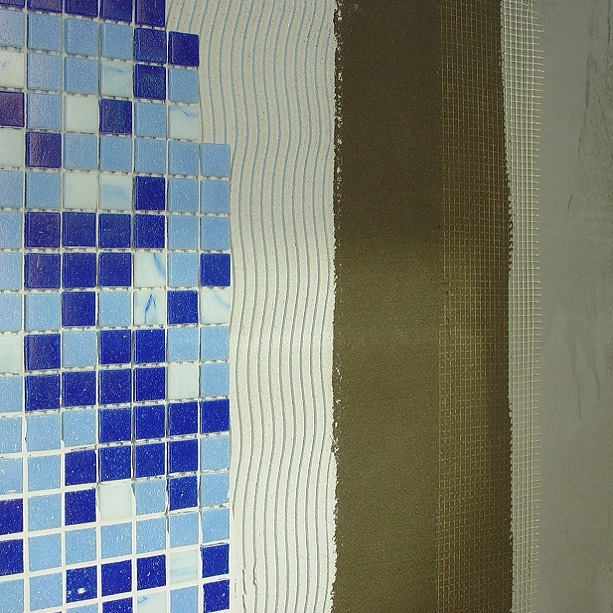
The waterproofing must be executed in two layers, with reinforcing mesh embedded between them. It increases the mechanical strength and resistance of the system under temperature and structural loads. A 120 mm wide elastic reinforcing strip must be installed along all horizontal and vertical edges between the two layers of waterproofing to strengthen corners and critical areas. This is necessary as the reinforcing mesh in these areas breaks and cannot provide sufficient protection.
Additionally it is recommended to form chokers on all horizontal edges of the pool, as well as on the compensatory tank in pools with an overflow chute. This measure reduces the stresses and the risk of cracking in the areas of increased load.
Bonding and grouting of the tiles
It is recommended to use a white-coloured adhesive for gluing the lining. When using grey adhesive, there is a risk of glazing at lighter joints, which deteriorates the final aesthetic result.
When selecting a jointing material, it should be borne in mind that cement-based joints have limited durability and typically last up to four seasons. Aggressive chemical ingredients in the water gradually lead to their deterioration. For this reason, the use of epoxy grouts is recommended. They are a two-component paste which, after application, polymerises into a hard and resistant mass that withstands chemical attack and intensive use.
To compensate for temperature expansion, expansion joints must be formed every 3 metres and at all corners. These are carried out using special silicones designed for swimming pools.
Compliance with the technological sequence
When applying the waterproofing, adhesive and joint compound, it is essential to strictly follow the manufacturer's prescribed technology. Deviations from this can lead to the compromise of the liner and shorten the service life of the pool.
Specifics for pools with overflow chute
In basins with an overflow chute, particular attention should be paid to the treatment of the chute itself and the compensating tanks. It is advisable to protect these areas by applying epoxy paint, which provides reliable protection and is easy to maintain.
Design features
At construction of swimming pools it is essential that the construction stages are properly planned and executed to ensure the long-term watertightness and stability of the facility.
In practice, pools are usually constructed in two stages - initially the bottom is poured, then the walls are concreted. To ensure a watertight seal at the working joints, it is advisable to use waterstop or swelling tape to prevent water penetration into the structure.