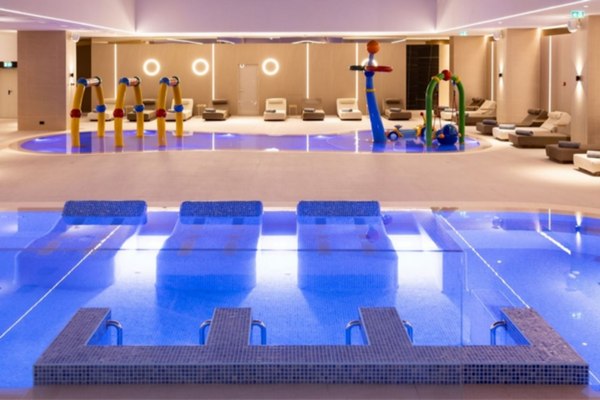
A home pool is not just a luxury - it is a long-term investment in comfort, health and property value. Building pools with quality materials and professional workmanship provides a sustainable and aesthetically pleasing solution for your backyard. Whether you're looking for an area for relaxation, sports or social gatherings, the right design and contractor are the keys to years of enjoyment.
Planning before pool construction
The construction of a swimming pool is a long-term investment that requires careful planning. It is at this stage that the foundations of a successful project are laid - making the right choices at this stage will save you problems and unnecessary costs in the future.
1. Terrain analysis
Before building a swimming pool it is important to make a detailed analysis of the terrain. The site should be sunny to reduce the need for additional water heating. It is not recommended to choose open areas with frequent currents, as the wind cools the water and introduces dirt. In addition, stable terrain is critical to the longevity of the pool - more unstable soils may require reinforcement work. It is also important to ensure sufficient access for machinery, such as excavators and material transport, which is best discussed in advance with the company responsible for building the pool.
2. Determination of size and shape
When determining the size and shape of the pool, it is important to consider several key factors. The size of the yard is key - the pool should be proportionate to the space available, leaving enough area around it to make the area as comfortable and functional as possible. The depth usually varies between 1.2 and 1.6 metres, but a deeper area can be provided for sports purposes. If a children's area is planned, a shallower area is appropriate in a certain part of the pool. As for the shape, rectangular is a classic choice and best suited for swimming, while oval or individually designed pools give a more luxurious and aesthetic look.
3. Functionality and purpose
- Family swimming pools - with a shallow area for children and convenient access with stairs or beach area.
- Sports pools - longer and deeper, suitable for swimming and training.
- Luxury pools for relaxation - with hydromassage jets, lighting, heating and automation.
4. Environment
When planning a swimming pool it is important to consider the environment. The location needs to be close to water mains and sewers to ensure easy water supply and drainage. In addition, there must be access to electricity, which is needed for the operation of the pumps, lighting and heating systems. The area around the pool also requires attention - it can be landscaped with decking, loungers, landscaping, and canopies or canopies that add to the comfort and finished look of the space.
5. Budget and future maintenance
Not only the initial investment, but also the long-term maintenance - filtration, heating, water treatment - should be considered at the planning stage.
Professional consultation with company for the construction of swimming pools will help you choose the most economical and efficient option for your budget and needs.
Types of pool construction
Concrete swimming pool construction - the gold standard

Concrete pools are the preferred choice for homeowners looking for durability and a custom solution.
Advantages of concrete pools:
- Durability - their life is measured in decades.
- Flexibility in design - can be built in any shape and size.
- A luxurious finish - mosaic, tile or marble finishes give a unique look.
- Possibility to integrate extras - hydro massage systems, lighting, heating, automatic cleaning.
Disadvantages of concrete pools:
- As a disadvantage of concrete pools, we can highlight the complex and involved construction process, the longer pool build time and the higher cost.
Fibreglass pools (Polyester pools)

A very good alternative to concrete pools are polyester pools. In these, the pool structure is pre-moulded plastic reinforced with polyester fibres. It is delivered whole and placed in the pre-prepared trench. This type of pools guarantees 100% waterproofing, saves the wet and dirty process of pouring the concrete, saves the making and maintenance of liners. As a disadvantage we can point out the limited dimensions, limited by the fact that they are transported whole.
Advantages of polyester pools:
- Absolute watertightness - they are made as one unit, like one big plastic tub and this ensures zero possibility of leaks through the construction
- Easy to maintain surface
- Easy installation without wet construction processes
Disadvantages of polyester pools:
- Limited shapes and sizes - as great as the variety of shapes and sizes are, they are still limited by transportation options. You can't order a polyester pool in the shape and size you want - you have to take into account the ready-made products on offer
- Ability to scratch the surface with hard objects
Swimming pools with metal construction (Prefabricated swimming pools)

Also a good alternative to concrete pools are the various types of prefabricated pools, where the pool structure is assembled from prefabricated metal or plastic panels. This also saves a lot of wet processes. Usually, different types of specialised liner are used to line this type of pool, which can be seen as a limitation and a disadvantage if you want, for example, a tile pool.
Advantages of prefabricated swimming pools:
- Lower price compared to others
- Easy installation with minimal construction processes
- Easy to transport
Disadvantages of prefabricated swimming pools:
- The linings are mainly PVC foil, they cannot be lined with ceramic or similar linings
- Shorter lifetime compared to other types of pools
Stages in the construction of a swimming pool
Concrete pool

Building a concrete pool is the most flexible and customized option for anyone looking for a sustainable and individual solution. Although the process is longer and more labour intensive, the result is a pool that can be completely tailored to the client's wishes, design and terrain. Every stage of the build is key - getting it right from the start ensures trouble-free operation and long life.
1. Design and preparation
It all starts with an individual project according to the shape, depth and space in the yard.
Tiling, equipment and additional extras - steps, overflow, hydro massage and lighting are selected.
At this stage, the technical drawings are also prepared in accordance with regulatory and safety requirements.
2. Excavation and site preparation
The excavation is carried out according to the design with the help of machinery.
Unstable soils are removed, a stable subgrade is formed and, if necessary, drainage is made to carry away groundwater.
This provides a solid foundation for the future structure.
3. Construction and reinforcement
Reinforcement is installed - a steel grid that reinforces the concrete.
The concrete for the walls and bottom is then poured, and the pre-filtration pipes, skimmers and nozzles are installed at the same time.
This is the foundation that guarantees the strength and durability of the pool.
4. Waterproofing
After the concrete cures, a waterproofing is applied to protect against leaks and moisture.
Special materials resistant to pressure, chemicals and temperature differences are used - a must for any concrete pool.
5. Cladding and finishing
The pool is lined with a material of your choice - tile, mosaic, glass ceramic or natural stone.
The cladding adds style but also protects the structure.
Edges, steps and decorative elements are shaped at this stage.
6. Installation of the equipment
Filter systems, pumps, skimmers, nozzles and lighting are installed.
Heating and automatic systems can be added if desired.
After installation, the pool is tested and prepared for commissioning.
7. Shaping the area around the pool
Stone, wood or composite flooring is laid, furniture, showers and landscaping are added.
Thus the pool fits naturally into the yard and becomes a complete relaxation space.
Polyester pools (fibreglass)

Here the process is significantly faster because the pool comes as a finished "shell" from the factory.
1. Design and model selection
It all starts with choosing the right model. Fibreglass pools come in a wide variety of shapes - rectangular, oval, with built-in steps, lounging areas or children's sections.
The customer also chooses the equipment - filtration system, lighting, heating, automatic cover, massage jets, etc.
The exact position of the pool in the yard is also determined at this stage, taking into account the terrain, access for installation and solar exposure. Read more information about fibreglass pools.
2. Excavation and site preparation
Once the model is selected, the excavation work proceeds.
The terrain is prepared according to the factory dimensions of the pool - a trench is formed, the bottom is leveled and a stable pad is made. Most often this is a layer of concrete or tamped sand, which provides uniform support of the structure.
If necessary, a drainage system shall also be constructed to protect against groundwater.
3. Installation of the pool
This is one of the most exciting stages. The finished hull arrives on site and is carefully placed into the prepared trench with the help of a crane.
Installation is precise - the pool is precisely levelled to be perfectly horizontal.
This process usually only takes a few hours, which is a huge advantage over traditional concrete pools that can take weeks to build.
4. Fixing and filling
Once the pool is in place, the space between its outer walls and the trench is gradually filled with dry concrete or tamped sand.
This is done in parallel with filling the pool with water to equalize the pressure and avoid deformation.
This ensures stability, proper fixing and durability of the structure.
5. Connecting the equipment
Next comes the installation of the systems that will keep the water clean and the pool functional.
The pipes, filters, pump, skimmers, nozzles, and lighting are installed. If desired, a heating system, automatic chemical dosing or hydro-massage can be added.
All components are tested to ensure safety and efficient operation.
6. Shaping the area around the pool
The last step is about design and comfort.
Surfacing around the pool - stone, wood, terracotta or composite. Edges, steps and decorative borders are built.
Furniture, lounge chairs, showers and appropriate landscaping are added to turn the space into a true zone for relaxation and enjoyment in the summer.
Swimming pools with metal construction (Prefabricated swimming pools)

Prefab pools are a great choice for people who want a quick and economical solution for their yard or garden. They are lightweight, easy to assemble and do not require major construction work.
1. Site selection and site preparation
The first step is to choose a level, stable and well-drained surface.
It is important that the site is easily accessible and with the ability to connect electricity and water.
The terrain is leveled, cleared of stones and roots, and for larger models a thin concrete pad can be made for better stability.
2. Assembly of the structure
After the preparation, the assembly of the support structure begins.
Depending on the model, it can be made of metal panels, PVC frames or combined modules.
All parts are assembled according to instructions, and the process is relatively simple and often does not require specialized equipment.
3. Installation of the lining
Once the structure is ready, the inner foil (liner) is applied to ensure watertightness.
The foil is carefully stretched so that there are no creases and fixed to the pool walls.
This is the main element that gives the finished look and ensures the durability of the structure.
4. Connecting the equipment
Next comes the installation of the filtration system - usually a filter pump, skimmers and hoses.
They ensure the circulation and purification of the water to keep it clean and clear throughout the season.
In larger models additional systems can be added - lighting or heating.
5. Water filling and tests
Once everything is assembled and connected, the pool is filled with water.
A check of all connections shall be performed to ensure there are no leaks and the system is operating properly.
After the tests the pool is ready for use.
6. Shaping the area around the pool
For a more finished look, a wooden podium, decking or decorative fence can be added around the pool.
This not only improves the look but also makes access easier.
If desired, a small relaxation area with sun loungers and umbrellas can be created, turning the pool into a cozy place to relax in the summer.
How long does it take to build a pool?
The time frame depends on the complexity of the project and the size of the pool, but usually:
Concrete pools:
- for a standard concrete pool - between 6 and 10 weeks;
- for larger or design solutions with additional extras - up to 3-6 months.
Polyester pools:
- 1-2 weeks
Prefabricated swimming pools:
- 1-2 weeks
Factors that can extend the time are: adverse weather conditions, terrain features, or design changes during construction.
Are permits required for pool construction?
In Bulgaria, the construction of a swimming pool falls within the scope of building legislation. This means that:
- Small ornamental or above ground pools may not require a permit;
- For concrete pools almost always necessary building permit;
- the design must comply with safety, drainage and electrical requirements;
- In some cases, coordination with neighbouring properties is also required.
It is therefore important to trust an experienced company for the construction of swimming poolsthat knows the regulatory framework and can undertake the whole process - from design to commissioning.
Modern trends in swimming pools for the home
Today's customers are looking for not just a water facility, but a complete relaxation area. Among the most popular trends are:
- Infinity pools - infinite effect with water overflow.
- Salt treatment systems - healthier alternative to chlorine.
- LED lighting - creates a unique atmosphere in the evening.
- Automated systems - temperature control, filtration and cleaning via mobile app.
- Different types of automatic coversproviding security and saving up to 60% on heating costs
The construction of a swimming pool is a serious project that requires proper planning, quality materials and professional execution. With experienced professionals, you'll get not just a pool, but a true area for enjoyment and relaxation in your own home.